It Is Our People’s Right to Have Electricity
Narrator: Nasrin (wife)
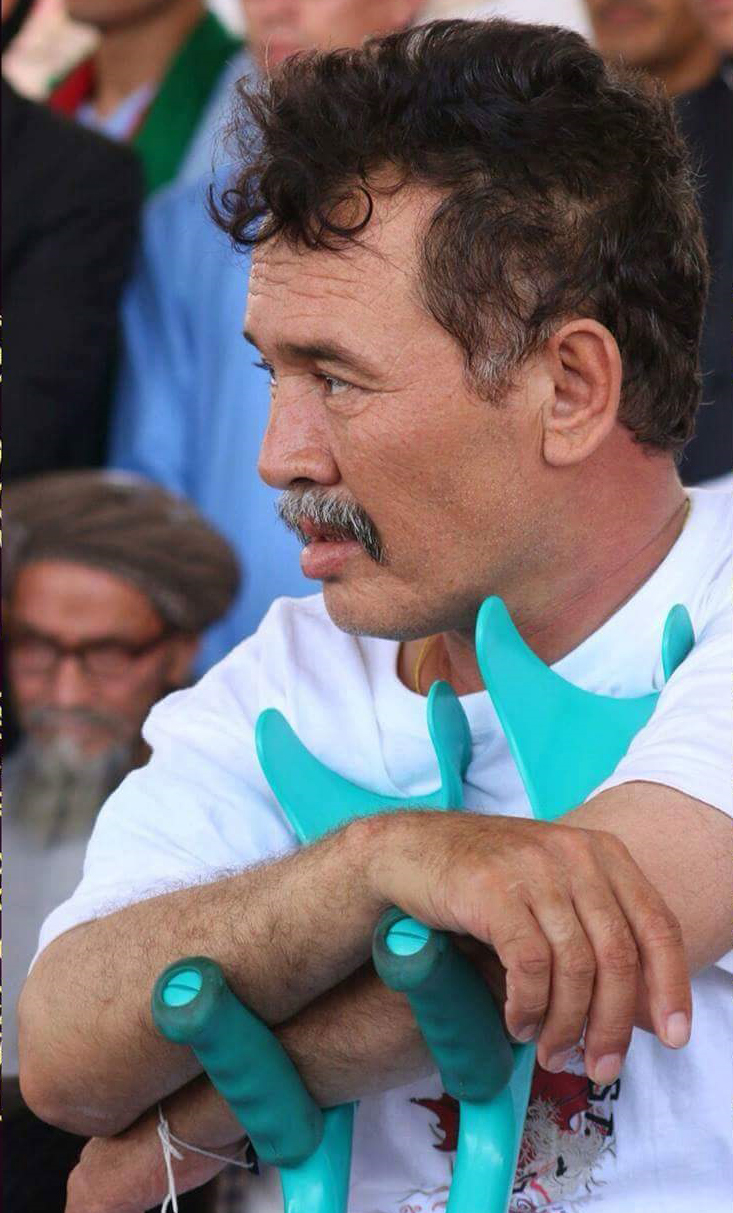
Victim: Amir Mohammad Rahimi
Date of the incident: 23 July 2016
Location of the incident: Dehmazang, Kabul City
In the name of God,
I am Nasrin, the wife of the martyr Amir Mohammad. I have 5 children, two girls and three boys. We come from Bamiyan Province, in the district of Shibar, from Shanbal Village. We currently live in Kabul. Amir Mohammad was 45-years-old when he was martyred. However, I found out his age was recorded as older than that on his Tazkira (National ID Card).
Hamed, The Martyr’s Son:
My father was born in Kabul in 1970. He attended the Asif Mayil High School in Qala Nazer up to the 12th grade. My father had very good manners and morals and always encouraged us to do good deeds.
The Martyr's wife:
He studied up to the 12th grade. After that, he did not continue with his studies because of his difficult financial situation, and he started working. Sixteen years had passed since our marriage. He behaved very well with everyone and was a sociable and friendly person. He was very benevolent and calm. At home, he treated me and my children well. He always told us that we should defend our rights. Before the 23rd July demonstration, he would go to Mosala to participate in social events, especially those related to the Movement. He used to participate in the early meetings of the Movement and when he came home, he would talk about the right of our people. He used to say: “Electricity is a right of our people and we will stand up against the government if it violates our rights.”
He was self-employed. In the winter season, he worked with his cousin who had a store, selling Turkish stoves in Qala-e Nazer. My husband was literate and his cousin was illiterate, that's why he managed the finances of his cousin’s store. His cousin was the store owner and Amir Mohammad managed the store’s financial affairs. His dream was for his children to get an education. He was always kind at home and believed that there should not be a tense environment at home when life was already so difficult.
When the issue of the 23rd July demonstration came up, I did not consent to him going to Dehmazang. I told him I did not want him taking part in the demonstration because an attack might happen. He answered, “We belong to this land and it is the right of our people to have access to electricity. We must defend the rights of our people and stand up against injustice.”
Hamed, The Martyr’s Son:
At first, it was decided that he would not go and take part in the demonstration. We tried to prevent my father from going, but his enthusiasm and his love for the people made him go to Dehmazang. We were watching the Dehmzang demonstration live on TV when the suicide attack happened. We immediately called my father to know where he was. He said he was in Dehmzang and had been injured. He was taken to Imam Ali Hospital. We got to the hospital. Since it was very crowded at this hospital and it was not possible for the staff to take care of all the patients, we transferred him to the Imam Zaman Hospital in Barchi.
The Martyr's wife:
His back was wounded, but he was not hurt severely. When we took him to the Imam Zaman Hospital, the doctor could not operate on him properly. At first, we didn't notice anything. But after a few days, his condition worsened. He suddenly had a seizure. We took him to the Rahel Hospital. They explained that all the fluid in his head was leaking into his body, and this was causing a problem with the lack of fluid in his brain. He was operated on again, but did not recover. The bullet had hit his back, but his spinal cord was not hurt.
Hamed, The Martyr’s Son:
First, we took him to Naser Khosrow Hospital. They told us there was a good specialist at the Imam Zaman Hospital in Barchi who could operate on the wounded, that's why we took him there and the doctor at this hospital operated on him.
The Martyr's wife:
When we visited him, Amir Mohammad said, "A police pick-up truck came in Dehmazang and I got on the back of the truck.” There were other wounded with him and that is how he got to the hospital.
Hamed, The Martyr’s Son:
At that time, his condition was not so serious. His legs were hurt, one leg was fractured, but it was not severe. In the Square, he wanted to find my cousin who was there at the demonstration, but he could not find him, and so he managed to get into the pick-up truck and get to hospital.
The Martyr's wife:
We took him to another hospital. Following the surgical operation, his legs stopped moving. Before the first operation, his leg was simply fractured due to the blast that had thrown him onto the ground. The doctor was dishonest; he didn't tell us before the operation that he didn't have the ability to perform the surgery. It would have been better if we could have transferred him to a better hospital or take him to Pakistan or India for the operation. After the operation, Amir Mohammad remained in a coma for four days. He never again opened his eyes. He repeatedly had seizures, and his brain fluid leaked through his back. He was hospitalized for four days in Rahel Hospital.
Hamed, The Martyr’s Son:
Preparations were made for taking him to India; we wanted to take him abroad for treatment, but he died before that could happen.
The Martyr's wife:
After my husband’s martyrdom/death, I went to the doctor to file a complaint. I asked him why he had performed such a critical operation when he lacked the know-how. He had nothing to say. When he met me, he held his head down; he was clearly embarrassed. I said to the doctor that he should have told us to take him to India or Pakistan for treatment. “Why did you do something that was beyond your ability?” Every time he examined my husband, he said, “It is okay, let this fluid come out of his body, because this is pus.” White fluid like milk came out of his back. Sometimes he could not straighten himself up easily; his back could sometimes not move. My husband died because of the negligence of this doctor. His leg was slightly fractured in the incident, and if the operation had not been done in that hospital, he could still be alive today.
I will never forgive this doctor because he ruined our life. After my husband’s martyrdom, my brother-in-law has been helping us because my son has to go to school; he can’t work. Now we have no other choice. God took my husband from us and we cannot do anything other than remain patient.
I ask the government to pay attention to the families of the Martyrs. The independent human rights commission should investigate this crime. My children are all young; my youngest son is just three years old. Now they are helpless. Their uncle can only help us for one year. The economic situation in the entire country is already bad without one family having to support another family for a long time. Since my children are young, I can't work and leave them alone. So, if there is any sewing or embroidery opportunity that I can do from home, I will definitely start working. My children must get an education and have a bright future.